 Sr. No. 163, Paiki No. 37/38 , Morbi, Gujarat-363641, India.
 +91 99783 43488
 info@polluxporcelano.co.in

Indian Porcelain Tiles vs Italian Porcelain Tiles: The Real Difference in Quality, Price & Design
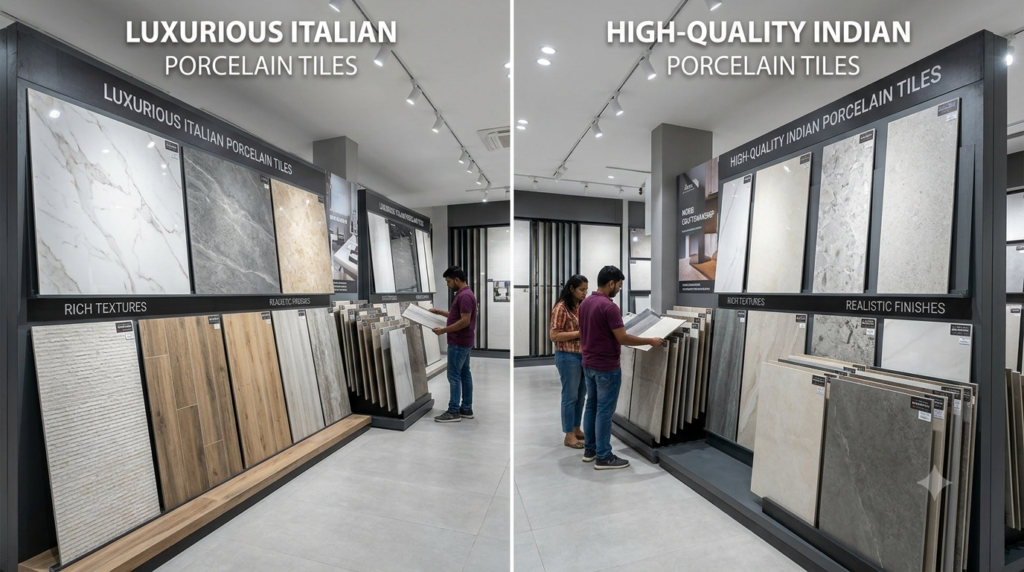
When you walk into a luxury showroom or plan a high-end architectural renovation, one question pops up constantly: Should you go with world-renowned Italian craftsmanship or the rapidly evolving, cost-effective Indian manufacturing powerhouse?
Choosing the right flooring or wall cladding is a long-term investment. While Italian porcelain tiles have historically set the benchmark for interior design worldwide, top-tier Indian manufacturers—such as Pollux Porcelano—have bridged the technology gap significantly in recent years. In this comprehensive guide, we will unpack the real differences in quality, price, aesthetics, manufacturing standards, and practical application so you can make the perfect choice for your space.
Indian Porcelain Tiles vs Italian Porcelain Tiles: What Is the Real Difference?
At first glance, both Indian and Italian porcelain tiles might look virtually identical when laid out in a modern living room or commercial lobby. However, the fundamental difference comes down to history, heritage, design philosophy, and raw material access.
-
Italian Porcelain Tiles: Italy is widely considered the cradle of modern ceramic and vitrified design. Italian manufacturers focus heavily on design innovation, subtle color gradations, exclusive natural stone replication, and ultra-high-end aesthetics. They cater primarily to luxury residential projects, flagship retail spaces, and high-end boutique developments.
-
Indian Porcelain Tiles: India, particularly ceramic hubs like Morbi, has rapidly grown into one of the largest tile manufacturing and exporting forces on the globe. Brands like Pollux Porcelano combine state-of-the-art Italian machinery with local manufacturing efficiencies. The result is high-performing, stylish porcelain tiles produced at a fraction of the European production cost.
The core distinction isn’t necessarily about performance anymore—it’s about heritage and cost structure versus value engineering and mass customization.
Italian Porcelain Tiles vs Indian Porcelain Tiles: Comparing Quality & Durability
When it comes to strength, density, and longevity, both regions adhere to strict ISO standards, but nuances exist in raw material selection and quality control.
| Feature | Italian Porcelain Tiles | Indian Porcelain Tiles (e.g., Pollux Porcelano) |
| Water Absorption Rate | Extremely low (< 0.05% to 0.1%) | Extremely low (< 0.05% to 0.1%) |
| Breaking Strength & Hardness | High Mohs hardness scale rating (7–8) | High Mohs hardness scale rating (7–8) |
| Raw Material Purity | Sourced from refined European clay, feldspar, & quartz | High-grade local and imported clays & minerals |
| Quality Control Consistency | Strict EU standard batch-to-batch variation checks | Advanced automated sorting by brands like Pollux Porcelano |
Both tile types are non-porous, frost-resistant, stain-resistant, and suitable for high-foot-traffic areas. Italian porcelain tiles often feature slightly more stringent tolerances on dimensional calibration and planarity out of the box. However, premium Indian lines from Pollux Porcelano utilize imported Italian press technologies that offer equal mechanical strength, making them equally capable of enduring heavy wear and tear over decades.
How Do Italian Porcelain Tiles Differ in Design, Finish & Appearance?
Design is where the contrast becomes most noticeable to the trained eye.
1. HD Digital Printing & Texture Depth
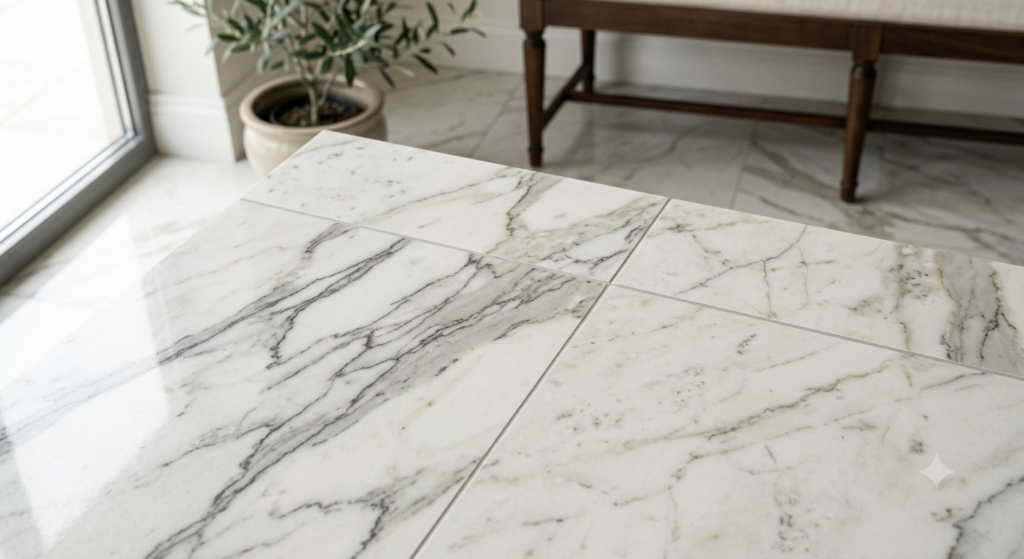
Italian designers excel at creating intricate, non-repetitive face patterns. When you view Italian porcelain tiles designed to look like Calacatta marble or rustic oak, you might see up to 30 or 40 unique tile faces before a pattern repeats. The veining depth, micro-relief textures, and subtle gloss variations are deeply layered.
2. Surface Finishes
While Indian manufacturers offer popular polished, glossy, matte, and carving finishes, Italian brands lead in specialized tactile finishes—such as velvet-soft matte, satin touch, and ultra-realistic reactive glazes.
3. The Indian Design Evolution
That being said, Indian brands like Pollux Porcelano have made massive strides. By collaborating with international color houses and utilizing 3D digital inkjet printing, Pollux Porcelano delivers stunning book-matched marble looks, metallic glazes, and modern geometric textures that closely match European aesthetic trends without the premium designer markups.
Italian Porcelain Tiles vs Indian Tiles: Understanding the Price Difference
The price tag is often the decisive factor for home builders, contractors, and architects.
[ Average Cost Per Sq. mtr. Comparison ]
Italian Porcelain Tiles : $$$$$ ($8.00 – $25.00+ / sq.mtr.)
————————————————————
Indian Porcelain Tiles : $$ ($3.00 – $7.00 / sq.mtr.)
Why Are Italian Porcelain Tiles So Expensive?
-
Import Tariffs & Freight: International shipping, import duties, logistics, and localized distributor markups significantly inflate the final price.
-
R&D and Branding: Decades of global brand marketing and continuous investments in proprietary design patents add to the overhead.
-
EU Manufacturing Costs: Higher energy, labor, and compliance costs in Europe naturally elevate production expenses.
Why Do Indian Porcelain Tiles Offer Superior Value?
Indian manufacturers benefit from competitive domestic production costs, localized raw material sourcing, and massive economies of scale. When you purchase from an established brand like Pollux Porcelano, you are paying directly for material quality and technology rather than heavy import tariffs or transit overheads.
Manufacturing Process: How Italian and Indian Porcelain Tiles Are Made
Understanding the factory floor helps clarify why both options deliver exceptional technical specs.
-
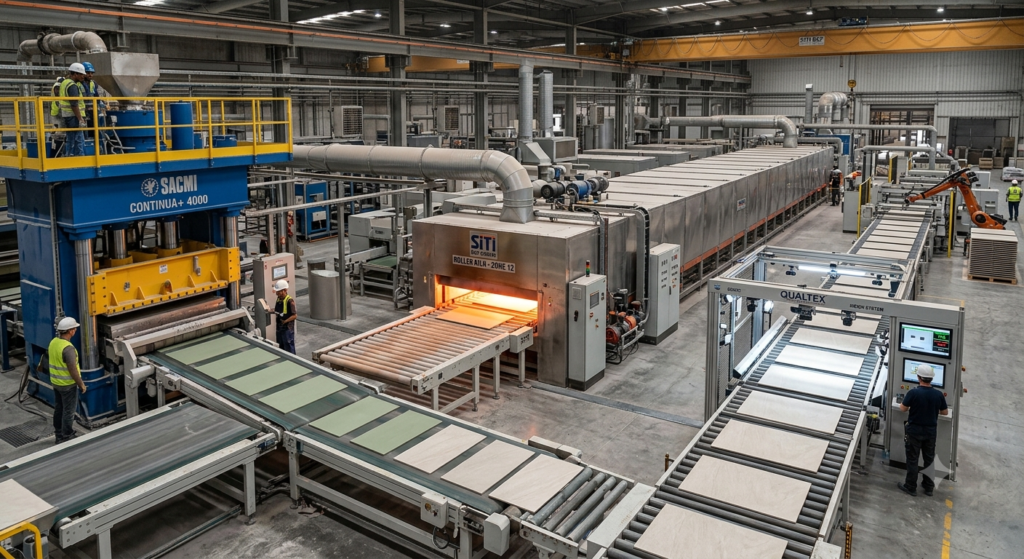
Body Preparation: Premium clays, quartz, and feldspar are finely ground into a liquid slurry, spray-dried into a fine powder, and stored in silos.
-
High-Tonnage Pressing: Modern continuous belt presses or SACMI hydraulic presses (commonly imported by leading Indian manufacturers like Pollux Porcelano) compress the body powder under tremendous pressure (exceeding 4000+ tons).
-
Digital Glazing & Decorating: High-definition inkjet printers apply rich pigment designs and textures onto the un-fired tile body.
-
Kiln Firing: The tiles enter long roller kilns, reaching temperatures between 1,200°C and 1,250°C. This vitrification process fuses the raw minerals into a dense, non-porous glass-like body.
-
Rectification & Polishing: Nano-polishing machines trim edges precisely so tiles can be laid with minimal grout lines (1.5mm–2mm).
Because companies like Pollux Porcelano utilize the same SACMI and System Italy machinery as European facilities, the physical manufacturing steps are essentially equivalent.
Which Is Better for Your Project? Italian Porcelain Tiles or Indian Porcelain Tiles
Selecting between the two depends heavily on your budget, project scope, and design priorities.
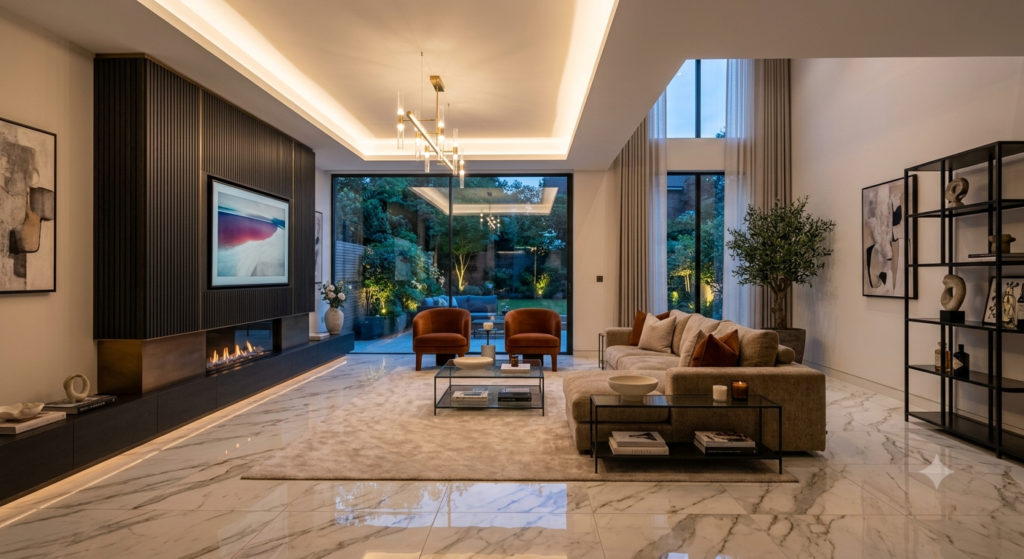
Choose Italian Porcelain Tiles If:
-
You are working on an unrestricted luxury budget (ultra-high-end villas, luxury hotels, high-end retail flagships).
-
You require rare, highly specialized finishes or specific exclusive European designer collections.
-
Brand prestige and European heritage are primary requirements for your architectural specs.
Choose Indian Porcelain Tiles (Pollux Porcelano) If:
-
You want high durability, low porosity, and premium aesthetics while keeping project budgets optimized.
-
You need quick delivery times, large stock availability, and flexible order volumes for medium to large-scale developments.
-
You prefer value-driven luxury—getting the look of premium natural stone and Italian porcelain tiles at a sensible price point from Pollux Porcelano.
Italian Porcelain Tiles vs Indian Porcelain Tiles: A Complete Buyer’s Guide
To sum it up, here is a quick checklist to guide your purchasing decision:
-
Set Your Budget Early: Calculate total square footage including 10% wastage. If freight costs and import taxes drive the price beyond your comfort zone, pivot to high-end Indian tiles.
-
Verify Technical Specifications: Check PEI abrasion resistance ratings, anti-slip co-efficient (R-ratings for outdoor/wet spaces), and water absorption certificates regardless of origin.
-
Inspect Sample Batches: Always request full-size physical samples. Observe how light reflects off the finish and check tile edge straightness (rectification).
-
Partner with Trusted Brands: Opt for reputable manufacturers. Pollux Porcelano provides extensive catalog selections, rigorous quality testing, and consistent batch coloring, ensuring your installation remains seamless from start to finish.
Both choices bring unique strengths to the table. While Italian porcelain tiles remain the classic benchmark for luxury design heritage, forward-thinking manufacturers like Pollux Porcelano prove that high-quality, durable, and breathtakingly stylish porcelain flooring is accessible across modern architecture worldwide.
Inquiry Now